
Views: 0 Author: Site Editor Publish Time: 2026-06-24 Origin: Site


Many vehicle owners approach aftermarket floor protection harboring a healthy dose of skepticism. Generic options constantly promise a flawless universal fit for any cabin layout. Instead, you often encounter severely bunched edges, exposed factory carpets, and dangerous safety hazards near your control pedals. Fortunately, the automotive industry is transitioning rapidly away from legacy rubber and carpet liners. Modern engineering now delivers vastly superior solutions leveraging advanced material science and digital metrology. Our core purpose here is to demystify the exact manufacturing and measurement processes utilized by top brands today. You will learn how a premium custom 3D TPE car mat achieves absolute OEM-level precision across highly diverse vehicle architectures. We will also equip you with strict, practical evaluation criteria to help you select the perfect protective interior upgrade.
Precision Engineering: True custom fitment relies on sub-millimeter 3D laser scanning of the specific vehicle's floor pan, not generic templates.
Material Superiority: TPE (Thermoplastic Elastomer) provides the necessary structural rigidity to hold a 3D molded shape without curling, unlike traditional rubber or PVC.
Safety First: Vehicle-specific design ensures zero interference with accelerator/brake pedals and perfectly aligns with factory retention posts.
Model-Specific Nuances: From heavy-duty SUVs to compact EVs, a valid custom mat must account for unique cabin elements like seat tracks, battery placements, and rear-seat folding mechanisms.
Universal floor liners rely on a fundamental design compromise. They utilize broad geometric templates meant for scissors. You must manually cut away excess material along pre-scored lines. This inevitably destroys the structural integrity of the outer border. You rarely cover the critical dead pedal area adequately. Fluid containment completely fails when you trim off the raised protective edges. Furthermore, generic smooth bottoms shift dramatically under heavy foot load during daily driving.
Modern manufacturers ditch physical templates completely. Elite engineering teams utilize professional-grade optical and laser metrology tools. They capture the exact topography of your vehicle's floor pan down to the sub-millimeter level. The laser plots millions of individual data points across the interior cabin. It maps every subtle curve, elevation change, and factory mounting post accurately. This rigorous data collection creates a flawless digital twin of your specific floor layout.
Translating digital scans into physical products requires intense computational power and heavy machinery. The production workflow follows strict industrial standards:
Engineers import the raw point cloud data into advanced CAD software.
They digitally sculpt high-wall edges and functional surface fluid channels.
The finalized digital blueprint drives heavy-duty CNC milling equipment.
CNC machines carve identical geometric shapes into solid steel injection molds over several days.
These massive steel molds demand a significant upfront capital investment. However, they guarantee scalable, identical, and absolute precision for every single end-user.
TPE stands for Thermoplastic Elastomer. It acts as a highly advanced hybrid compound bridging two distinct material categories. It seamlessly combines the desirable flexibility and tactile grip of traditional vulcanized rubber. Simultaneously, it retains the exceptional dimensional stability found in rigid plastics. This unique chemical blend makes it perfectly suited for demanding automotive environments. It easily resists spilled coffee, corrosive road salt, and acidic mud.
Exact structural measurements become entirely useless if the base material degrades rapidly. Cheaper aftermarket alternatives warp easily over a short period. TPE confidently maintains its high-wall edges and molded contours. It withstands extreme cabin temperature variations flawlessly. Automotive interiors act like greenhouses during summer afternoons. You will not experience annoying edge sagging under intense UV heat. The material also completely prevents brittle cracking in sub-zero winter conditions.
Premium formulations prioritize passenger health and enclosed air quality. Reputable manufacturers ensure their chemical compounds hold official SGS certifications. They test rigorously for harmful phthalates and heavy metals. The material remains completely non-toxic and entirely odorless right out of the box. This resolves a major consumer pain point linked tightly to cheaper PVC alternatives. Nobody wants toxic chemical off-gassing trapped inside their daily commuter vehicle.
Understanding the core differences between available materials helps clarify why TPE dominates modern interior protection.
Material Type | Shape Retention | Temperature Tolerance | Odor Profile |
|---|---|---|---|
Thermoplastic Elastomer (TPE) | Excellent (Holds rigid 3D borders) | High (Resists warping and cracking) | Completely Odorless |
Traditional Rubber | Poor (Limits designs to flat profiles) | Moderate (Can degrade over time) | Strong natural rubber scent |
Polyvinyl Chloride (PVC) | Moderate (Prone to edge curling) | Low (Off-gasses in extreme heat) | Harsh chemical smell |
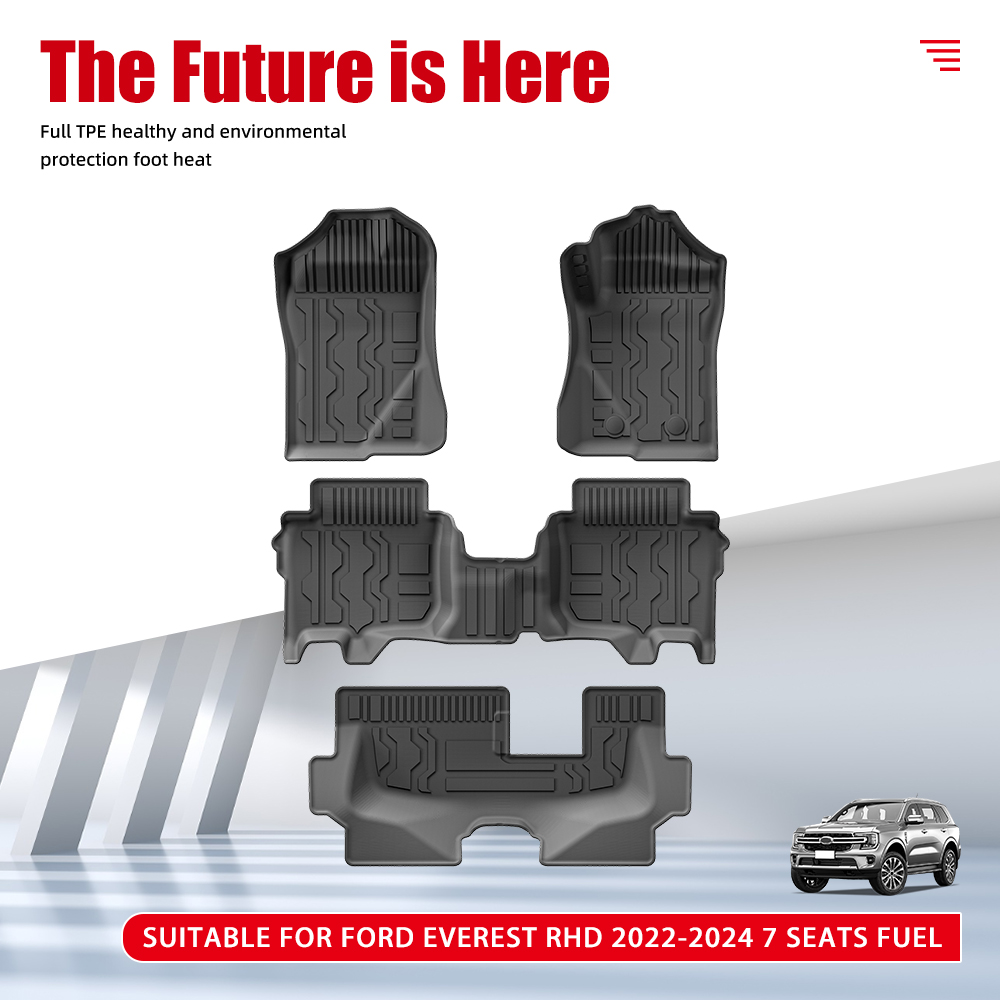
Heavy-duty family SUVs require incredibly robust internal protection. Take the Ford Everest car mat as a perfect structural benchmark. A custom design here must strictly account for multi-row seating configurations. It must wrap flawlessly around complex sliding seat tracks without rubbing. The surface material must defend high-traffic wear zones efficiently. Passengers constantly step in and out of the third row. Crucially, the engineered borders accomplish all this without blocking any mechanical seat tumbling actions.
Unibody pickup trucks present distinctly different cabin topographies. Consider the specific spatial demands of a Honda Ridgeline car mat. It must accurately accommodate specialized rear-seat folding mechanisms. The design needs to map specific under-seat storage clearances accurately. Exact digital scanning ensures the protective vertical walls clear these unique utility features. It keeps your clever cargo areas fully functional while delivering maximum carpet protection against muddy gear.
Electric vehicles introduce very tight and unconventional spatial constraints. Looking closely at a Nissan Sakura car mat provides an excellent reference point. Compact electric platforms demand ultra-precise pedal clearances. They frequently feature completely flat floorboards raised significantly by the underlying battery pack. They lack traditional transmission tunnels entirely. The protective liner must sit perfectly flush against these broad raised sections. Any structural deviation here ruins the interior aesthetic and creates massive tripping hazards.
Ill-fitting accessories present severe and immediate safety risks for drivers. Accelerator entrapment remains a heavily documented automotive danger investigated by national safety administrations. Thick or poorly molded borders can trap the gas pedal easily during acceleration. True laser scanning eliminates this critical risk completely. Engineers match exact OEM clearance specifications during the initial mold creation. They ensure structural walls steer safely clear of all moving mechanical levers, even under full pedal depression.
You cannot rely solely on basic floor friction to hold barriers in place. A verified custom solution must actively utilize the factory retention clips. They integrate seamlessly with standard floor hooks, twist-locks, or OEM snaps. The shear force generated by a heavy winter boot is immense. Proper mechanical anchoring guarantees zero forward slippage under aggressive braking conditions.
We must address a very common post-purchase phenomenon transparently. High-quality 3D products often arrive folded inside their compact shipping boxes. Buyers frequently worry about these initial bends and prominent creases. Here is the underlying technical reality. Thermoplastic Elastomer possesses an inherent and strong molecular memory. It actively wants to return to its original scanned shape. Brief exposure to moderate heat initiates this physical memory recall. You can simply leave them in warm direct sunlight for an hour. Using a standard heat gun on a low setting works perfectly too.
Knowing exactly how manufacturers design these products empowers your purchasing decisions. You need a reliable framework to evaluate different aftermarket options efficiently. Always cross-reference product descriptions against these specific technical markers:
Look for key manufacturing terms: Find "Injection-molded" or "Thermoformed" deep in the product specifications. These specific processes ensure high-edge retention and proper structural rigidity over years of use.
Verify precise compatibility: Confirm the exact model year and specific drivetrain trim level. Hybrid and standard gas models frequently possess distinctly different floor pans due to battery pack placements.
Check the proprietary backing: Look for advanced anti-slip backing textures. Features like integrated geometric nibs or specialized fibrous bottoms prevent micro-shifting. They must actively work alongside standard factory clip compatibility.
Be extremely cautious of online listings grouping too many model years together. A description boldly reading "Fits 2010-2024" usually indicates a compromised, generic mold. Vehicle platforms undergo massive interior changes over fourteen years. Avoid products lacking specific trim exclusions in their fitment notes. Furthermore, never finalize a purchase without verifying a clear fitment guarantee. A transparent return policy serves as your ultimate quality safety net.
Achieving a flawless interior fit is never a random manufacturing accident. It strictly requires precise data collection through advanced 3D scanning protocols. Engineers must pair this structural data perfectly with advanced material science. Investing in a verified custom upgrade immediately mitigates severe driving safety risks. It actively protects your vehicle's delicate factory carpets and preserves long-term resale value. It also heavily reduces ongoing interior maintenance and weekend cleaning efforts. Always prompt yourself to check your specific vehicle's floor pan details thoroughly. Verify your exact hybrid battery placement or unique multi-row seating configurations. Confirm these physical nuances before you submit your final order.
A: Yes, provided the manufacturer has archived the 3D scan data for that specific generation. Tooling for discontinued models remains active if consumer demand exists. Always verify the exact chassis code or specific generation year before ordering. Never assume cross-generation compatibility.
A: Thermoplastic Elastomer holds an incredibly strong thermal memory. You can easily fix shipping creases by utilizing ambient or direct heat. Lay the product perfectly flat in direct sunlight for 30 to 60 minutes. Alternatively, gently passing a heat gun over the crease quickly restores its molded contours.
A: Premium manufacturers design their units using specialized friction-based backing materials. They calculate exact edge-to-edge tension against the interior cabin walls. This specific multi-layered approach firmly locks the piece into place. It prevents unwanted shifting effectively, even when OEM retention posts are entirely absent.
A: Frequently, yes. Large battery pack placements often alter the rear floorboard height considerably. They also change available under-seat dimensions and central transmission tunnel designs. You cannot interchange these variations safely. Buyers must purposefully select the specific drivetrain trim when placing an order.


